





Attorneys
Related Practices
Traditionally, any seller in the chain of distribution of a defective product may be held liable for injuries caused by that defect.[1]
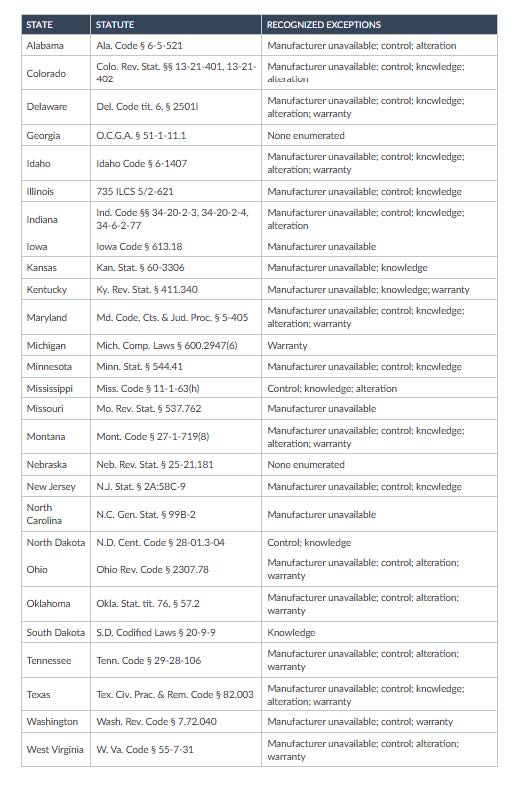
However, 28 states have enacted some form of innocent-seller statute that shields nonmanufacturing sellers such as retailers from product liability claims to some extent.[2] The rationale is that product safety is ultimately the manufacturer's responsibility, while retailers are merely conduits.[3]
Other states without these statutes have considered enacting them, which indicates that interest in this type of legislation isn't static, and likely will result in more innocent-seller statutes in the future.
For example, Arizona considered substantially similar bills in 2020 and 2022, which would have limited product liability actions against nonmanufacturing sellers. Neither bill was ultimately enacted, so Arizona has not yet closed this gap in seller protection.
Massachusetts has repeatedly considered legislation creating a comprehensive innocent-seller regime, most recently in 2025. S.B. 1218 was sent to study on July 16, 2025, but was not advanced before the relevant Massachusetts legislative session concluded on July 31, 2025.
In the South Carolina Legislature, H.B. 5444 was introduced on March 26 of this year. It was referred to the House Judiciary Committee that same day, but did not advance before the close of the regular legislative session in May.[4]
Relevant for national retailers, the scope of these innocent-seller statutes varies, as each state has implemented its own set of exceptions that remove innocent-seller protections under specific circumstances.
Practically speaking, the statutory exceptions to the innocent-seller statutes often swallow the rule, requiring retailers to spend more time and effort proving they do not fall within an exception than establishing that the statute applies in the first place.[5]
The U.S. District Court for the Southern District of Texas' May 14 summary judgment ruling in Simien v. Walmart Inc. illustrates both the significant protection innocent-seller statutes can provide and the importance of understanding the statutory exceptions that often determine whether a retailer remains in a case.
In that case, a woman asserted strict product liability claims against Walmart after she allegedly contracted toxic shock syndrome from defective Walmart-branded tampons that were manufactured overseas.[6]
Applying Texas' innocent-seller statute, the court dismissed the claims against Walmart on ummary judgment because the plaintiff failed to prove that any of the statutory exceptions applied.[7]
Innocent-seller exceptions vary widely in number and substance across statutes, but are almost always a combination of those adopted by other states. Indeed, in many circumstances, an exception in one state may be a combination of two or more exceptions in another state.
Thus, retailers that operate in only one state can focus on the specific exceptions in their state and strategize accordingly. National sellers, on the other hand, have no such luxury and must instead be familiar with the most common exceptions so they can strategize accordingly with an eye toward dismissal, generally at the summary judgment stage.
Common Exceptions to Innocent-Seller Protection
Although terminology and structure vary from state to state, the statutory exceptions generally fall into five recurring categories.[8]
Manufacturer Unavailable (20 States)
The most common among innocent-seller statutes, this exception will generally prevent the dismissal of a retailer when the manufacturer cannot be identified, is insolvent,[9] cannot be served, is judgment-proof or is not subject to the court's jurisdiction (i.e., foreign manufacturers).[10]
The idea is that the court will afford the retailer immunity so long as the plaintiff is not deprived of recourse as a result.[11] But the rise of foreign manufacturers selling through online marketplaces may place additional pressure on this exception.
Illinois lawmakers, for example, proposed legislation in the most recent legislative session that would impose liability on certain sellers and online marketplaces for foreign-manufactured products.[12]
Seller Control Over Design or Manufacturing (18 States)
The second-most common exception applies when the retailer ceases acting as a passive conduit and instead exercises some degree of control in the design and/or manufacture of the product.
While the wording of this type of exception is generally consistent among states, courts have yet to establish a clear dividing line when faced with the question of how much control is sufficient to establish that the exception applies.
Some courts have found that requesting certain product features and quality certifications is not sufficient to establish control, but imposing specific performance standards and engaging in quality assurance testing is.[13] Similarly, exercising control over labeling or advertising may expose the seller to liability.[14]
Notably, this exception requires proof of causation. To be liable, the seller must have controlled the aspect or feature of the product that allegedly caused the injury.[15]
Seller Knowledge of the Defect (15 States)
In states where this exception exists, sellers that knew a product was defective before selling it will not be protected by the innocent-seller statute.[16]
Some states impose liability where the seller knew or should have known the product was defective (constructive knowledge), while others require hard evidence (actual knowledge).[17]
Importantly, the seller must have known that the product feature was unreasonably dangerous, not just that the dangerous feature existed.[18]
Seller Alteration or Modification of the Product (13 States)
A derivative of the intervening cause doctrine, this exception provides that if a seller alters a product in a manner that renders it defective, the seller can be held liable.[19]
In several states, failure to observe routine care and maintenance will also remove the protections of the statute.[20] Again, the alteration must have caused the alleged injury for the seller to be liable.[21]
Seller Made an Express Warranty or Independent Representation (12 States)
If a customer relies on a statement or representation by the retailer or its employee, and is injured as a result, the retailer faces an uphill battle claiming it is an innocent seller.
Courts have distinguished mere puffery from factual representations. Descriptions such as "good" or "safe" do not trigger the exception, while specific factual representations concerning a product's capabilities, characteristics or quality may bring a seller within the exception's scope.[22]
Any representation that exceeds a retailer's status as a seller in the stream of commerce may expose the retailer to liability.
Below is a comprehensive table of states with innocent-seller statutes, and the exceptions generally recognized in those jurisdictions:
Building an Innocent-Seller Defense
Because the statutory exceptions are highly fact-intensive, retailers rarely succeed at showing that the statute applies at the pleading stage.[23] Unless a plaintiff completely fails to plausibly allege facts establishing an exception, the claim will likely survive a motion to dismiss.[24]
Instead, retailers should approach every product liability case with the innocent-seller doctrine in mind from the outset, developing the evidence necessary to establish that no statutory exception applies.
This means:
- Maintaining current information regarding the financial viability of key
manufacturers; - Avoiding unnecessary involvement in product design, testing, labeling, advertising or product assembly that could be perceived as exercising control over these processes;
- Preserving documentation confirming that manufacturers — not retailers — bear responsibility for product safety; and
- Training employees to avoid factual representations that exceed manufacturer specifications.
As discovery progresses, retailers should also prepare corporate witnesses to provide clear testimony — and, where appropriate, affidavits and supporting documents — to show that the retailer remained a passive seller, and that no statutory exception applies.
By identifying the required proof early and building the evidentiary record strategically throughout discovery, retailers can reduce the likelihood that a court will find a genuine dispute of material fact on the issue of whether an exception applies, thereby significantly improving their chances of obtaining summary judgment.
Finally, national retailers should monitor both innocent-seller legislation and emerging online marketplace liability proposals, particularly where foreign manufacturers are involved, because those developments may materially alter the protections available to them.
“This article first appeared in Law360 on September 11, 2026, and is republished here with permission from the publication.”